The Lower Eastern Times Opening The Third Eye

For years, residents living along the seasonal Enziu River in Kitui County have depended on its waters for domestic use, farming, and livestock keeping. Today, however, many say the river is slowly losing its ability to sustain life due to uncontrolled sand harvesting.
Among those witnessing the transformation firsthand is Peninah Munyoki, a resident of Mwania village in Nguni Ward, Mwingi Central Sub-county. She describes the relentless extraction of sand from the river as a growing crisis that has left communities grappling with environmental degradation, water scarcity, and social challenges.
Click here to join our WhatsApp Channel
According to Munyoki, excessive sand harvesting has significantly lowered groundwater levels, making access to water increasingly difficult, especially during prolonged dry spells. She says the situation has been worsened by heavy trucks operating within the riverbed, which pollute water sources through fuel leaks and emissions.
The effects are particularly evident in Mwania village, where residents say natural springs that once flowed throughout the year have disappeared. The few remaining water points are either drying up or becoming increasingly saline, making them unsuitable for household use.
Women and girls have emerged as the hardest-hit group. With nearby water sources disappearing, they are forced to travel longer distances in search of water, often spending hours away from home. This not only increases their workload but also exposes them to insecurity and family disputes.
READ ALSO: Kitui Senator Declares War on Sand Harvesting Cartels
Activist to Camp at Tyaa Bridge Until Illegal Sand Harvesting Stops
Sand Harvesting Transporters Must Obtain Licenses, Says NEMA
Kitui County Passes Sand Utilization and Conservation Bill
The environmental damage has also undermined agricultural production. Continuous excavation along riverbanks has accelerated soil erosion and reduced soil fertility, leading to lower crop yields and worsening food insecurity. Women, who traditionally shoulder the responsibility of feeding their families, now face greater challenges in providing food for their households.
Community Divisions Deepen
Residents say efforts to push for tighter regulation of sand harvesting have received little response, even as tensions within communities continue to rise.
Munyoki recalls a violent clash earlier this year involving residents from Kaunguni and Mwania villages. The confrontation left one person dead and several others injured, including women who reportedly suffered physical and sexual violence.
According to residents, the conflict highlighted the growing divide between those advocating for environmental conservation and individuals benefiting economically from the sand trade.
The lucrative nature of the business has also attracted children, raising concerns about its impact on education and social welfare. Community members report that some learners have abandoned school to work at sand harvesting sites, while others are drawn into risky activities linked to the trade.
Girls are particularly vulnerable, with reports of teenage pregnancies, school dropouts, and child marriages increasing in areas where sand harvesting is prevalent. Boys, meanwhile, are often recruited to load sand onto trucks for modest pay, choosing quick earnings over education.
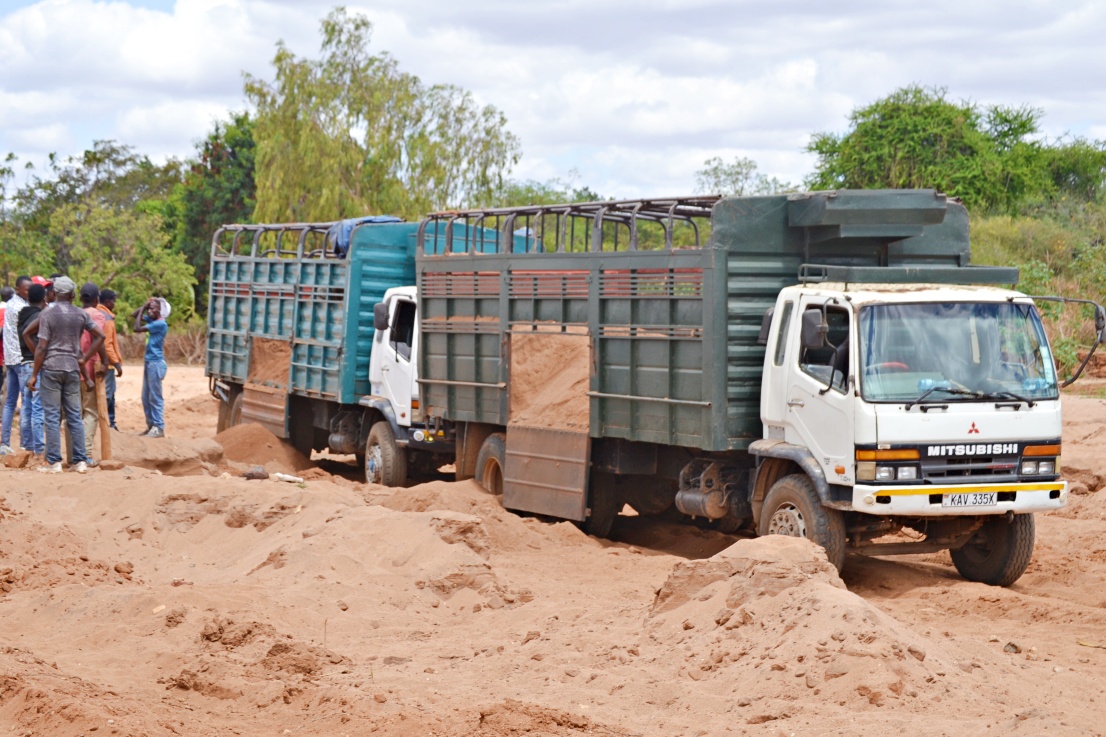
Residents further warn that children frequenting the sites are increasingly exposed to drugs, illicit alcohol, and exploitation by outsiders involved in the sand business.
Education and Security Concerns Mount
Kasyoka Musila, another resident, says the sand trade has become a major source of insecurity in the area, creating hostility between opposing factions within the community.
She notes that threats and confrontations have become common, fueling fears of further violence.
Musila also points to the devastating impact on young girls, many of whom are reportedly exposed to sexual abuse, early pregnancies, and forced marriages. Such circumstances often force them out of school and leave families struggling to support both the girls and their children.
The effects are reflected at Mwania Comprehensive School, where enrolment has dropped sharply in recent years.

PTA chairperson Mwanziu Muthuvi says the school population has fallen from about 500 learners to roughly 300 as more children abandon their studies to engage in sand-related activities.
Some learners leave after becoming pregnant, while others fall victim to drug abuse or early marriages linked to the sand trade.
Nguni Assistant County Commissioner James Munene confirms that school dropout cases have risen significantly. He says at least 24 children from 13 families have left Mwania Comprehensive School since the beginning of the year, with some suspected to have joined sand harvesting operations.
Authorities, he adds, are preparing interventions aimed at returning affected children to school and addressing the underlying causes of the problem.
Growing Calls for Action
Environmental conservationists warn that the consequences of unchecked sand harvesting could be long-lasting if urgent action is not taken.
David Masauru, an official with the Upper Enziu River Basin Water Resources Users Association, explains that sand plays a critical role in storing water beneath riverbeds. Excessive extraction disrupts this natural process, causing groundwater levels to decline.
He says communities across the Enziu River Basin are already experiencing severe water shortages, while irrigation farming has reduced significantly due to dwindling water supplies.
The decline has affected horticultural production, increased food insecurity, and threatened livelihoods that depend on agriculture. Fruit trees such as mangoes are drying up, tree nurseries are collapsing, and beekeeping activities are suffering as vegetation and water sources disappear.
Masauru warns that continued degradation could eventually turn productive riparian zones into barren landscapes, forcing residents to relocate in search of better living conditions.
Kitui County Environment Executive Richard Mwendandu acknowledges that uncontrolled sand harvesting has contributed to widespread land degradation, soil erosion, biodiversity loss, and declining agricultural productivity.

He says the county government is implementing the Kitui County River Basins Sand Utilisation and Conservation Act through the establishment of sand cooperatives, management committees, designated collection yards, and enforcement structures.
At the same time, NEMA County Director Catherine Adunga notes that commercial sand harvesting requires approved Environmental Impact Assessment reports and valid licences. Despite extensive sand mining activities in the region, only a handful of sites currently meet these legal requirements.

Although enforcement measures remain available, Adunga says authorities prefer to pursue compliance through structured regulation before resorting to arrests and prosecutions.
For residents living along the Enziu River, however, the need for intervention is becoming increasingly urgent. As water sources continue to diminish, agricultural productivity declines, and more children abandon school, many fear the river’s deterioration could become a stark example of the consequences of uncontrolled exploitation of natural resources.