 The Lower Eastern Times Opening The Third Eye
Related Articles


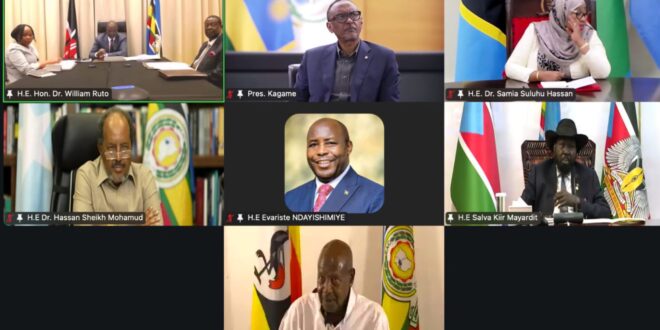
An emergency East African Community (EAC) summit in Nairobi has urged the Congolese government to engage all parties in the ongoing conflict, including the M23 rebel group and other armed factions, to put an end to the violence.

The summit, convened by President William Ruto, took place virtually on Wednesday night, but DRC President Félix Tshisekedi chose not to attend.
Click here to join our WhatsApp Channel
The summit was attended by Rwanda’s Paul Kagame, who faces accusations of involvement in the conflict, Uganda’s Yoweri Museveni, Tanzania’s Samia Suluhu, Somalia’s Sheikh Mohamud, Burundi’s Evariste Ndayishimiye, and South Sudan’s Salva Kiir.
A joint communique from the summit called for an immediate, unconditional ceasefire and better humanitarian access to Goma, a city heavily affected by the fighting. The summit also condemned the recent attacks on foreign embassies in Kinshasa and urged the DRC government to ensure the protection of diplomatic missions and their staff after several embassies were looted.
The summit took place amidst widespread violence in Goma, where many bodies lay on the streets following intense clashes that have displaced over a million people. Rwanda is accused of supporting the M23 rebels, who have seized large parts of Goma, including its airport.
The Rwanda Defence Force (RDF) confirmed that 280 Romanian mercenaries, who had been supporting the Congolese army, surrendered to the M23. Rwanda denies providing direct military aid to the rebels, despite substantial evidence from the UN suggesting otherwise.
On Wednesday, Goma remained relatively calm, though sporadic gunfire was reported. Many residents, who had been sheltering in safe zones, ventured out to purchase increasingly scarce food supplies. While both the UN and the Southern African Development Community (SADC) have peacekeepers in Goma, they have been unable to stop the rebel advance.
Vivian van de Perre, deputy head of the UN peacekeeping mission in Goma, spoke about the worsening situation, noting that M23 rebels had solidified their control over the city but were still encountering some resistance. She emphasized the urgency of supplying food and water to UN bases, some of which were running low on supplies.
The M23 rebels, who are primarily ethnic Tutsis, have claimed their actions are in defense of minority rights in DRC. Tensions have risen as Rwanda’s Kagame, also a Tutsi, accuses DRC’s government of harboring Hutu militias linked to the 1994 Rwandan genocide.
Click Here To Subscribe To Our YouTube Channel
Recent clashes have overwhelmed hospitals and left bodies on the streets, according to the UN. Looting of warehouses containing food and medical supplies has compounded the humanitarian crisis. Essential services, including electricity, water, and internet, have been disrupted.
Protests in Kinshasa, sparked by anger over the rebel advance, led to attacks on at least 10 foreign embassies, with demonstrators calling for international intervention. The embassies were looted, and the international community was urged to step in.
The Romanian mercenaries, who had been in DRC to provide military training, were transported to Rwanda after surrendering to the M23. Although the Rwandan government claims they were part of a training mission, UN sources said they sought refuge in a UN base before being evacuated to Rwanda.
DRC accuses Rwanda of backing the M23 to gain control over the region’s mineral resources, a claim the Rwandan government denies. The region is rich in valuable minerals such as gold and coltan, which are essential for electronics and electric vehicle batteries.
