The Lower Eastern Times Opening The Third Eye
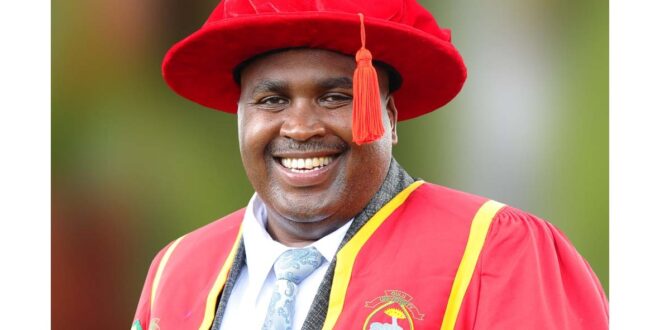
Professor Simon Gicharu, founder and chairman of Mount Kenya University (MKU), has called on the government to create an independent entity to oversee funding for higher education, advocating for a more sustainable system that moves beyond reliance on the national budget.
In a proposal to Education Cabinet Secretary Julius Ogamba, Gicharu highlighted the rapid growth of Kenya’s university sector in the last 15 years, with the number of institutions increasing to 79 and student enrollment almost doubling from 361,379 in 2013 to 620,480 in 2022.
Similarly, the Technical and Vocational Education and Training (TVET) sector has also seen growth, with enrollment rising from 60,667 in 2018 to nearly 460,000 in 2024.
Despite these advancements, Gicharu cautioned that the current funding model is unsustainable, as public universities are burdened by underfunding, unpaid bills estimated at Kshs. 80 billion, and operational issues. He pointed out that the government’s New Funding Model, which ties funding to student financial need, has encountered legal and logistical challenges, adding further pressure on the sector.
“The increasing number of students and the shrinking capacity of the national budget require a long-term solution. We need to move away from a grant-based system and implement a structured financing model that guarantees sustainability,” Gicharu said.
He proposed the establishment of a National Students Financial Aid Corporation, modeled after South Africa’s National Student Financial Aid Scheme (NSFAS). This new body would merge the Universities Fund and the Higher Education Loans Board (HELB), as recommended by the Presidential Working Party on Education Reform and approved by the Cabinet in January 2025.
Gicharu argued that the proposed independent entity should have the legal authority to secure funding from various sources beyond government allocations, such as education bonds, unclaimed financial assets, employer training levies, and contributions from private sector entities benefiting from skilled graduates.

“The funding body must have the ability to attract investment, raise alternative revenue, and implement effective loan recovery systems. This would ensure that all students can access higher education while securing the financial stability of our universities,” he explained.
He also suggested shifting from a grant-based financing model to a loan-based system, supplemented by performance-based scholarships for priority government programs.
With the government aiming to increase TVET enrollment to two million in the near term and university admissions expected to reach 290,950 by 2027, Gicharu emphasized that an independent funding mechanism is the only sustainable way to ensure long-term stability in the education sector.
“We must rethink our approach now. If we delay, we risk facing a funding crisis in education that could hinder Kenya’s efforts to develop a skilled workforce for the future,” he cautioned.