The Lower Eastern Times Opening The Third Eye

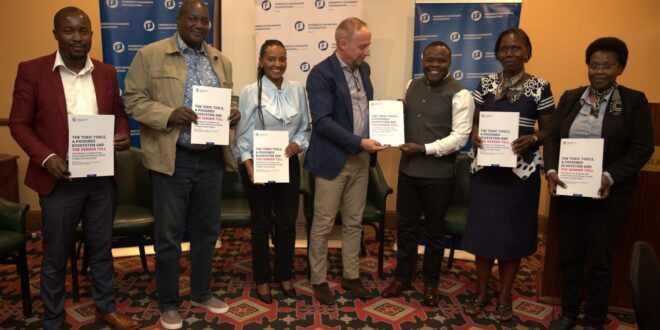
In Kenya’s Migori County—where artisanal and small-scale gold mining sustains nearly 40% of the population—a new report has revealed a serious and growing environmental and public health crisis linked to mercury contamination.
Click here to join our WhatsApp Channel
The Friedrich Naumann Foundation for Freedom – Kenya (FNF-Kenya) has released a study, published in April 2025, exposing dangerously high mercury levels in the region. The findings are based on field data collected in October 2024.
Mercury, commonly used to extract gold, is polluting local water sources, soil, and ecosystems at levels far beyond safe limits. Tests from areas near active mining sites detected mercury concentrations significantly above standards set by both the World Health Organization (WHO) and Kenya’s National Environment Management Authority (NEMA).
In some areas, water samples contained mercury levels up to 100 times above the safe threshold for drinking water. Similarly, mercury in soil and mining waste surpassed agricultural safety limits by two to three times, raising concerns over contamination of local food supplies.
At Nyangoto River—only six kilometers from an active mine—mercury levels were found to be more than 30 times the acceptable limit. However, for now, fish samples from the same location showed no signs of contamination.
“This is likely just the beginning,” said Stefan Schott, Project Director at FNF-Kenya. “There’s a lack of concrete data on how many people are involved in mining and what health risks they face. The danger may be bigger than we realize.”
The report also sheds light on social impacts, including rising school dropout rates as children leave school to work in mines. Gender inequality remains stark: men work underground, while women handle ore processing—but women earn less, face sexual harassment, and have little say in decision-making.
“Women play an essential role in gold production,” the report emphasizes, “yet they remain marginalized.”
In response, the study calls for urgent policy and regulatory action to address the risks of mercury use in mining. It advises residents to avoid using water from sources near mining areas and recommends better enforcement of environmental laws, fair wages, and training on safer mining methods.
Click Here To Subscribe To Our YouTube Channel
“Mercury exposure is a grave public health issue,” said mining survey expert Nashon Adero, who contributed to the report. “It reflects what I call the ‘Vicious 9Ds of Mining’: displacement, disputes, dispossession, deprivation, destitution, disease, degradation, deformity, and death. But mining, if properly managed, can drive inclusive development.”
The study also advocates for gender-sensitive reforms that support and protect women working in the mining industry.
Conducted between October 11 and 30, 2024, the research combined environmental sampling, interviews, and community engagement to explore the environmental, economic, and social consequences of artisanal gold mining—and propose sustainable solutions to limit its harmful impact.