The Lower Eastern Times Opening The Third Eye

Zambian President Hakainde Hichilema has officially begun his second five-year term in office, following a contested election in which his main challenger was arrested and charged with treason.
According to official results, Hichilema won the 13 August election with 60% of the vote, while his closest rival, Brian Mundubile, secured 38%. Mundubile rejected the result, claiming that the election figures had been manipulated.
The opposition leader was unable to challenge the outcome in court because the courts were reportedly closed off on the final day available for submitting a legal petition.
Although international observers described election day as generally peaceful, concerns were raised about how votes were counted and verified. European Union observers reported that officials at several counting centres failed to immediately record announced results on official tally sheets. They also pointed to shortcomings in checking electronic results against physical documents.
The observers further noted that counting frequently came to a halt as electoral officials waited for guidance from the central headquarters.
Tensions increased the day after the election when security forces raided a property in Lusaka associated with Mundubile. A former cabinet minister was killed during the operation, while several opposition figures were arrested.
Government officials accused opposition members of preparing an armed uprising, allegations that the opposition strongly denied.
Mundubile and his running mate, Makebi Zulu, subsequently went into hiding. Police eventually detained both men last week, and they were formally charged over the weekend.
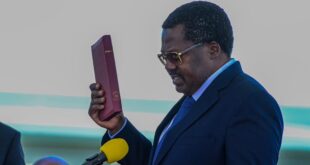
During his inauguration speech on Tuesday, Hichilema made no direct reference to Mundubile’s detention. Instead, he stressed the importance of maintaining national peace and stability, saying that political ambition should never undermine the country’s security.
He also called for tolerance between political rivals, arguing that democracy does not mean everyone must share the same views but requires people to respect each other despite their differences.
Hichilema extended an invitation to opposition parties to cooperate with his administration, promising that his government would consider constructive ideas from its political opponents.
The inauguration was marked by celebrations, with thousands of Hichilema supporters gathering at the National Heroes Stadium in Lusaka. His running mate, Mutale Nalumango, was also sworn in as vice-president.
Several African heads of state attended the ceremony, including the presidents of Kenya, Botswana, Zimbabwe, Namibia and Tanzania.
Hichilema, 64, first assumed the presidency in 2021 after winning by a wide margin. At the time, Zambia was facing serious economic difficulties, having recently defaulted on its international debt while annual inflation stood above 24%.
Before the latest election, Hichilema told the BBC in Lusaka that his administration had inherited a struggling economy and a country facing significant financial challenges.
His government subsequently reached an agreement to restructure Zambia’s debt and worked to improve relations with international creditors. Inflation has fallen, although the cost of living remains a major concern for many Zambians.
Entering his second term, Hichilema says his focus will now shift from economic recovery to stronger growth.
He said that the difficult work of stabilising the economy had largely been completed during his first term and that the next five years would focus on creating prosperity and improving the lives of Zambians. He also pledged to continue serving as president for the entire country.
The outlook for Zambia’s economy has received a boost from higher copper prices. Copper is particularly important to the country, contributing roughly 15% of GDP and more than 70% of exports, according to the World Bank. Bloomberg reports that investors remain optimistic about Zambia’s economic prospects despite concerns surrounding the disputed election and subsequent political developments.