The Lower Eastern Times Opening The Third Eye


A recent video has surfaced showing a Philippine ship being targeted by water cannons from China’s Coast Guard on April 30, 2024, near Scarborough Shoal.
Incidents like this have occurred before, reflecting the ongoing tensions in the disputed South China Sea.
The South China Sea is a significant and strategic body of water in eastern and southern Asia, covering an area of 3.5 million square kilometers. It is dotted with over 250 small islands, atolls, cays, shoals, reefs, and sandbars, most uninhabited and some submerged underwater at high tide.

Historically, during World War II in 1944, Japan deployed two of its largest warships, Musashi and Yamato, which posed a significant threat to their adversaries, including the United States.
Despite their size and power, both ships were sunk, resulting in the loss of at least 3,000 soldiers’ lives. They now lie at the bottom of the South China Sea, along with valuable treasures. However, this is not the major reason for the ongoing tension.
 8
8
The conflict over these waters involves not just China and the Philippines but also Taiwan, Vietnam, Brunei, and Malaysia, making it one of Asia’s most volatile conflict zones. On July 12, 2016, an arbitral tribunal largely supported the Philippines’ claims, ruling that China had not shown exclusive control within the nine-dash line and thus had no legal basis to claim “historic rights” over the area’s resources.
The United States has long been involved in the dispute, claiming to defend the sovereignty of its allies, including the Philippines, with whom it has a Mutual Defense Treaty since 1951, stipulating mutual defense in case of an attack.
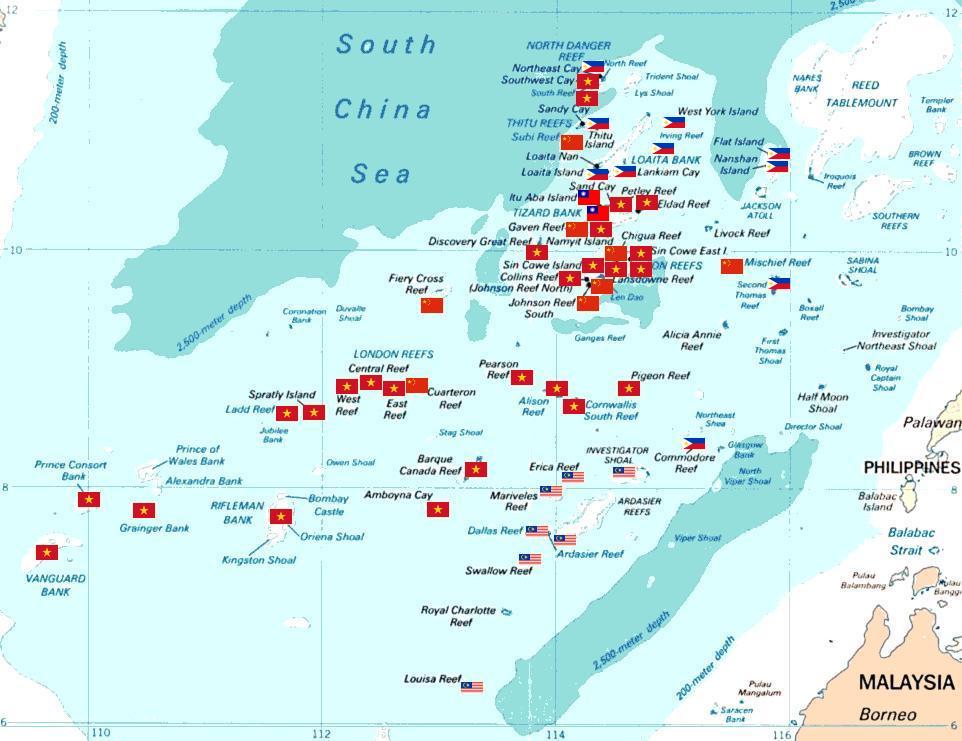
In March 2020, China had over 220 military vessels patrolling areas claimed by the Philippines, according to the United Nations. The South China Sea is a crucial global trade route, accounting for $3.4 trillion of the $16 trillion in global maritime trade. It also contributes to 10% of the global fishing catch and 30% of the global crude oil trade, with vital internet cables running along its seabed.

The region is rich in natural resources like gas and oil. Control over these resources is a significant source of conflict, with China claiming 34% of the oil and 66% of the methane gas deposits, while the Philippines claims 1% of the oil and 2% of the gas.
The legitimacy of these claims is at the heart of a dangerous dispute that could escalate into a major global conflict due to the high stakes involved.