The Lower Eastern Times Opening The Third Eye


Pope Francis’ funeral will take place at the Vatican on Saturday, April 26.
Tens of thousands of people, including many world leaders, are expected to attend.
What exactly will the ceremony involve – and how will it be different from the funerals of other popes?
Typically, a papal funeral service has three parts: the announcement of the death and a vigil in the papal residence; the farewell to the body and the funeral service in St. Peter’s Basilica.
Vigil: The Pope’s Residence
Pope Francis died on April 21 at 7:35 a.m. local time. His body was examined by the Vatican’s chief physician, Andrea Arcangeli, who determined the cause of death and wrote a report.
Pope Francis’ body, dressed in white, was then placed in a wooden coffin covered in zinc. The coffin was later moved from the papal apartments to the papal residence, Casa Santa Marta (House of Saint Martha).
There, the late pope was wearing red liturgical vestments, a turban (the traditional covering of bishops) and a pallium (a white cloth or scarf with embroidered crosses worn by archbishops and popes).
Camerlengo – the cardinal who serves as head of the Vatican from the death of a pope until a new election – Kevin Farrell presided over the ceremony to officially announce the pope’s death.
Two days after Francis’ death, on Wednesday, April 23, his body was transferred in an open casket from the Casa Santa Marta church to the main church of the Catholic Church, St. Peter’s Basilica.
There, for three days, believers and mourners can pay their respects to Pope Francis.
The procession from the Pope’s residence to St. Peter’s Basilica is accompanied by the Litany of All Saints.
Funeral Service: Saint Peters Square
Pope Francis’ funeral will take place on Saturday, April 26.
The evening before the funeral, at 8:00 p.m. Vatican time, the Camerlengo will preside over the sealing of the coffin, in the presence of other high-ranking cardinals.
The Pope’s face will be covered with a white silk veil, and coins minted during his papacy and a list of Francis’ deeds will be placed in the coffin.
Burial: Santa Maria Maggiore
After the funeral, Francis’ coffin will be taken to the church of Santa Maria Maggiore, one of the four papal churches in Rome. It is located outside the Vatican on the other side of the Tiber River.
The Pope requested in his will that he be buried in Santa Maria Maggiore. “I have always entrusted my life, my priestly and episcopal ministry to the Mother of Our Lord, Mary Most Holy,” the Pope explained.
He indicated in which part of the basilica he should be buried, and even included a plan.
Francis also requested that his tomb be “simple, without much decoration” with only the inscription: Franciscus.
Camerlengo Kevin Farrell will again lead the funeral procession.
Who will attend the funeral?
Many world leaders have already announced their intention to attend the funeral, from US President Donald Trump to Ukrainian President Volodymyr Zelensky.
But it is not yet known whether Zelensky will attend his father’s funeral on Saturday.
On Thursday, he was forced to cut short his visit to South Africa due to heavy Russian attacks.
Vladimir Putin, as his press secretary Dmitry Peskov said, will not go to the Vatican. Russia will be represented by Culture Minister Olga Lyubimova.
Tens – or hundreds – of thousands of believers are expected to gather in Rome.
About 50,000 people attended the funeral of Benedict XVI (who died after leaving the papacy) in 2023, and about 300,000 attended the funeral of Pope John Paul II in 2005.
Who pays for the funeral?
Francis’ will states that all expenses related to his funeral will be covered by an anonymous donor. The entire amount will be transferred directly to the Basilica of Santa Maria Maggiore.
How is this funeral different from the previous ones?
The rites associated with the funeral of a pope are described in detail in the Ordo Exsequiarum Romani Pontificis (Rite of Funerals for the Roman Pontiffs).
The first version of the law was approved by Pope John Paul II in 1998 and published in 2000. It is this version that was used after the deaths of John Paul II and Benedict XVI.
However, Pope Francis, who had the rare opportunity to watch the funeral of his predecessor as pope, requested changes to the text.
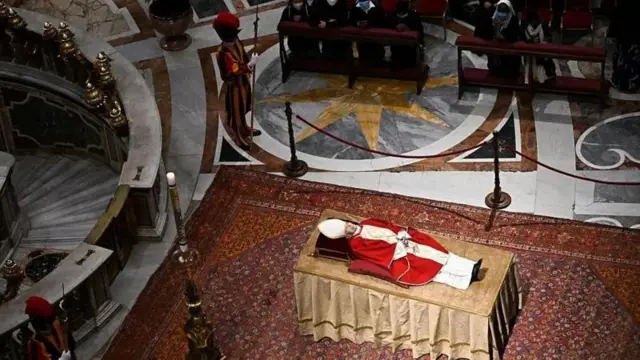
Image source,ALBERTO PIZZOLI/AFP via Getty Images
A new, simplified version was approved and published in 2024.
Major changes:
- The ceremony of announcing the death presided over by the Camerlengo is now held in the church, and not in the chambers where the pope died;
- The body of the shark is immediately placed in a coffin;
- Instead of three coffins placed inside each other (made of cypress wood), there is a wooden and zinc coffin;
- Originally the will of the deceased pope was shown to mourners in a hearse and without a coffin, now it is shown without a hearse and in an open coffin;
- The rules explain what to do if the pope wants to be buried somewhere other than St. Peter’s Basilica.
What’s next?
The funeral and burial are just the first day of a period of mourning in the Roman Catholic Church called novemdiales. It will last nine days.
And after that, a meeting is called to elect a new pope.
By: BBC