 The Lower Eastern Times Opening The Third Eye
Related Articles



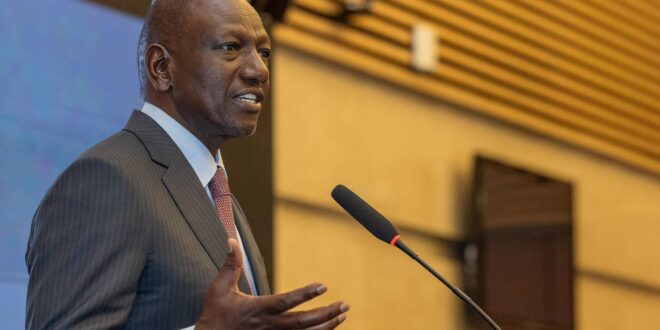
President William Ruto has called for the creation of an African Credit Rating Agency, criticizing international credit rating agencies for their flawed evaluations and unfair portrayal of African economies.
Speaking at the 38th ordinary session of the African Union in Addis Ababa, Ethiopia, Ruto highlighted how distorted assessments based on outdated models have inflated risks, resulting in unnecessarily high borrowing costs and significant losses for the continent, amounting to billions of dollars in missed opportunities.
“The statistics tell a troubling story. The Africa Peer Review Mechanism and the United Nations Development Programme estimate the cost of biased credit ratings at a staggering $75 billion in lost opportunities,” Ruto remarked.
Despite Africa’s abundant natural resources, vast agricultural land, significant remittances, and the world’s largest carbon sinks, Ruto pointed out that credit rating agencies have downgraded African countries by 94 percent in the past decade and designated only two nations as investment-grade.
He emphasized that these biased evaluations harm not only Africa but the world, as they hinder investments, distort global trade, and slow progress toward the Sustainable Development Goals (SDGs).
“By misjudging Africa, these agencies deny investors and economies opportunities and deprive nations of prosperity. It is time to rewrite our story, reclaim our narrative, and drive the African Renaissance forward,” Ruto declared.
Ruto’s remarks follow recent criticism from the African Union over Moody’s decision to revise Kenya’s credit outlook from negative to positive. The African Peer Review Mechanism (APRM) argued that this revision acknowledged that the original downgrade was premature, as it skipped the stable outlook phase.
On January 24, Moody’s upgraded Kenya’s outlook from negative to positive, maintaining its Caa1 rating due to improving liquidity risks and debt affordability. The APRM noted that it is rare for credit agencies to skip a stable outlook when changing credit ratings from negative to positive.
A Caa1 rating represents a high risk of default, signaling financial instability. The APRM also noted that Moody’s premature downgrade in July 2024 was speculative, as critical data had not yet been released when the rating was issued.
In his speech, Ruto stressed that Africa is ready to assert its influence in global progress and must establish a fair financial system based on transparency, merit, and equality.
“Africa will no longer accept being misjudged by criteria that ignore our realities. Change is on the horizon, and our progress is unstoppable,” he said.
Ruto outlined that the African Credit Rating Agency would not operate alone but collaborate with global partners who share values of dignity, equity, and development. The new agency must be credible, backed by solid data, and reflect Africa’s true situation, he added.
He noted that the agency would complement existing international credit rating organizations by addressing data gaps and applying transparent, scientifically grounded methodologies.
“We will hold rating agencies accountable, demand high standards, and work with Pan-African rating agencies to strengthen their capabilities and reach,” Ruto said.
The President also emphasized the significant benefits of Africa having its own credit rating agency. Research shows that improving Africa’s average credit rating by one level could unlock $15.5 billion in additional funding, surpassing official development assistance by 12 percent and meeting 80 percent of the continent’s infrastructure needs.
“This opportunity is within our reach, and we must act to seize it,” Ruto concluded.