The Lower Eastern Times Opening The Third Eye
Related Articles



Rwanda paid solemn homage to the victims of genocide on Sunday, marking 30 years since a brutal campaign led by extremist Hutus ravaged the nation, resulting in one of the most horrific massacres of the 20th century as Rwandans turned against each other. This relentless violence, spanning 100 days until the rebel militia of the Rwandan Patriotic Front (RPF) seized control of Kigali in July 1994, claimed the lives of 800,000 people, primarily Tutsis but also moderate Hutus.
Under the firm leadership of President Paul Kagame, who commanded the RPF, Rwanda has since made strides towards recovery, yet the wounds of the atrocities persist, leaving a profound impact across the Great Lakes region of Africa.
Following tradition, commemorations on April 7, the day when Hutu militias initiated the bloodshed in 1994, commenced with Kagame igniting a memorial flame at the Kigali Genocide Memorial, believed to hold the remains of over 250,000 victims. Accompanied by foreign dignitaries, including several African heads of state and former US President Bill Clinton, who acknowledged the genocide as a significant failure of his administration, Kagame laid wreaths at the mass graves amidst mournful melodies played by an army band.
The international community’s inaction during the genocide continues to evoke profound regret, with French President Emmanuel Macron anticipated to express remorse in a message, acknowledging that France and its allies, both Western and African, had the capacity to halt the bloodshed but lacked the resolve to do so.
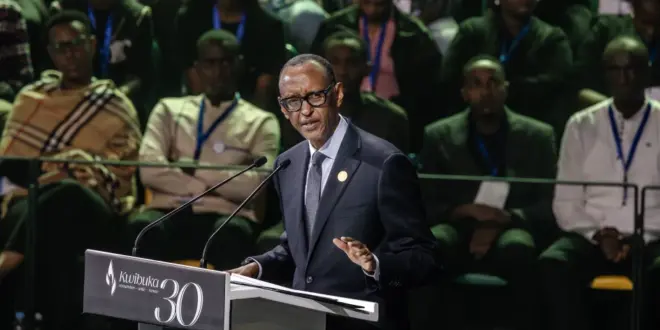
In a 10,000-seat arena in the capital, Kagame is scheduled to deliver a speech, followed by a candlelight vigil to honor the victims of the massacre.
This solemn occasion marks the commencement of a week-long national mourning period, during which Rwanda will observe moments of reflection, with flags flown at half-mast and restrictions on public entertainment. The United Nations and the African Union will also hold remembrance ceremonies.
Reflecting on the atrocities, Karel Kovanda, a former Czech diplomat, emphasized the imperative of preserving the memory of the genocide, cautioning against its descent into oblivion.
The genocide was triggered by the assassination of Hutu President Juvenal Habyarimana on April 6, 1994, catalyzing a frenzy of violence orchestrated by Hutu extremists and the “Interahamwe” militia. Fuelled by virulent anti-Tutsi propaganda disseminated through media channels, the killings involved shootings, beatings, and machete attacks, with a reported 250,000 women subjected to rape.
Rwanda has made efforts to reckon with its past, establishing community tribunals for victims to confront perpetrators, although this system has faced criticism for miscarriages of justice. Notably, Rwandan ID cards no longer denote ethnic affiliations, and the genocide is part of the secondary school curriculum.
The country hosts over 200 memorials dedicated to the genocide, including four recently added to UNESCO’s World Heritage list, housing artifacts and remains as poignant reminders of the horrors endured.
Despite these efforts, many perpetrators of the genocide remain at large, with Rwanda citing hundreds of suspects evading justice, some seeking refuge in neighboring countries like the Democratic Republic of Congo and Uganda. While France has tried and convicted several individuals for their roles in the genocide, tensions persist due to France’s historical support for Habyarimana’s regime.
In 2021, Macron acknowledged France’s complicity in the genocide and its dismissal of warnings preceding the massacres, yet refrained from issuing a formal apology.