The Lower Eastern Times Opening The Third Eye
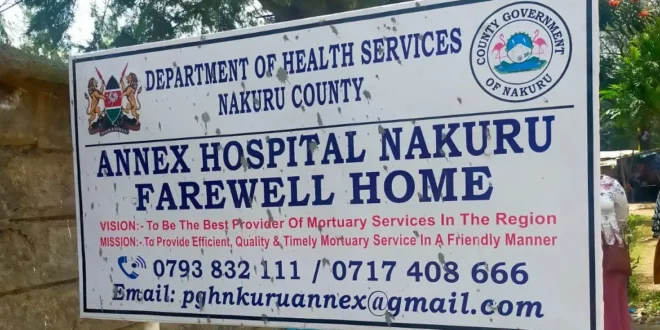
Nakuru County has announced that it will proceed to dispose of 49 unclaimed bodies currently held in its public mortuaries if they are not claimed within the next 21 days.
According to county officials, the bodies have been kept at the Nakuru County Teaching and Referral Hospital Mortuary and the Annex PGH Public Mortuary for more than three months, placing pressure on mortuary facilities.
In a public notice, County Chief Assistant Public Health Officer Mary Ayabei listed details of the unclaimed bodies, including where and when death occurred, as well as the cause of death.
The remains include 21 infants and 17 adults at the Annex PGH Public Mortuary, and 11 adult bodies at the Nakuru Teaching and Referral Hospital Mortuary.
The county urged members of the public to identify and collect the bodies of relatives or acquaintances within the 21-day window. Should no one come forward, the county will seek court approval to dispose of the remains.
While some of the deceased have been identified, others remain unknown, with most unidentified bodies having been recovered by police without formal identification documents.
County officials said disposal will only take place after obtaining a court order, in line with the Public Health Act (Cap 242). Ayabei noted that all efforts to trace next of kin have already been exhausted.
“If the relatives are not found, the bodies will be disposed of after twenty-one days at Nakuru South Cemetery,” the notice stated.
Public mortuaries regularly issue such notices to manage space and prevent overcrowding, after which unclaimed bodies are buried in public cemeteries or mass graves, often without funeral rites.
The Public Health Act provides that a body should not remain in a mortuary for more than 10 days. If unclaimed after 21 days, a hospital may dispose of it with court authorisation following a 14-day public notice.

The reported causes of death among the unclaimed bodies include road accidents, homicide, drowning, gunshot wounds, sudden death, abortion-related complications, mob justice, and a few natural causes.
Nakuru County mortuaries typically handle between 200 and 300 unclaimed bodies each year.
Several factors contribute to bodies remaining unclaimed, including lack of burial funds, cultural practices, land constraints, and communication breakdowns within families.
Counselling psychologist Ochieng Okuku explained that some families assume missing relatives are still alive due to lack of contact, only to later discover their bodies in mortuaries.
He added that many unclaimed bodies belong to unidentified individuals who died under violent or unclear circumstances, making it difficult for police to trace relatives due to challenges such as unavailable fingerprints.

Police play a key role in identifying bodies through fingerprint analysis, enabling families to make claims.
Experts noted that postmortem examinations are conducted by coroners to investigate deaths that are sudden, violent, or suspicious. Coroners ensure families are informed before bodies are released or disposed of.
Historically, such investigations were handled through public inquests under the Criminal Procedure Code, but the National Coroners’ Service Act of 2017 established a formal framework for death investigations. However, its implementation has stalled due to disputes over administrative oversight.
The Act shifts responsibility for investigating unnatural deaths from police to an independent coroner-general appointed through a competitive process.
Unclaimed bodies may also be legally transferred to medical training institutions for education and research, with approval from the Ministry of Health under the Anatomy Act.
The county noted that maintaining unclaimed bodies is costly, with preservation sometimes extending for up to four months.