The Lower Eastern Times Opening The Third Eye
By: Patrick Karanja, Jewel Technical College
At the northern base of Mount Fuji lies a forest so dense, so quiet, and so deeply unsettling that it has earned a reputation unlike any other on Earth.
This is Aokigahara Forest, a place where beauty and darkness exist side by side, and where the silence can feel heavier than sound itself. Known across the world as the Suicide Forest, Aokigahara is both feared and famous, drawing curiosity, caution, and sorrow in equal measure.
Click here to join our WhatsApp Channel
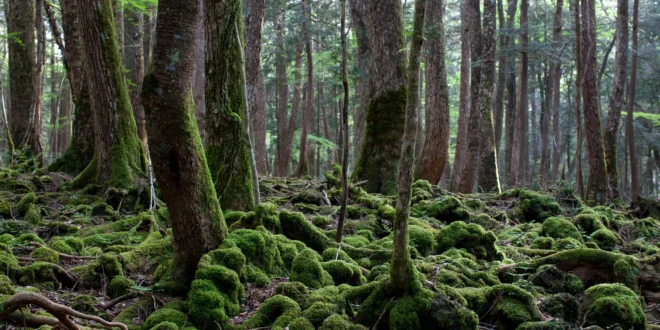
At first glance, the forest appears peaceful. Tall trees stretch endlessly in every direction, their roots twisting over hardened volcanic ground. Sunlight struggles to pass through the thick canopy, casting long shadows that seem to move even when the air is still. But step deeper inside, and the atmosphere changes. The sounds of the outside world fade away. No birds sing. No wind howls. There is only a deep, unnatural silence—one that presses against your ears and settles into your mind.
This silence is one of the reasons Aokigahara is so feared. Many who have entered describe a strange feeling of isolation, as if the forest itself is closing in around them. The volcanic soil beneath your feet absorbs sound, making footsteps almost impossible to hear. Even your own voice seems distant. In such conditions, it becomes easy to lose your sense of direction—and even your sense of self.
The forest’s terrain adds to its mystery. Formed on ancient lava flows from Mount Fuji’s eruptions, the ground is uneven, jagged, and unpredictable. Roots snake across the surface like traps, and hidden caves open into darkness below. Compasses and GPS devices have been known to behave strangely here, often blamed on the magnetic properties of the volcanic rock. For those who wander too far, finding the way back can become a frightening challenge.
Over the years, the forest has become associated with people who come here in moments of deep despair. This reputation has turned it into a place of sorrow, where human struggles have left a heavy emotional weight in the air. Authorities regularly patrol the area, placing signs at the forest’s edges with messages of hope, urging visitors to reconsider and seek help. These signs stand as quiet reminders that behind the forest’s mystery are real lives and real pain.
In Japanese folklore, spirits known as Yūrei are said to linger in places tied to strong emotions, especially grief and loss. Many believe Aokigahara is one such place. Visitors have reported hearing faint whispers, footsteps where no one walks, and sudden chills that cannot be explained. Whether these experiences are the result of imagination, fear, or something more, they have only deepened the forest’s haunting reputation.

Even seasoned hikers approach Aokigahara with caution. Some tie ribbons or markers to trees to avoid getting lost. Others refuse to leave the main paths entirely. Because once you step off the trail, the forest quickly becomes a maze—one that does not let you go. And yet, there is a strange pull to Aokigahara.
Perhaps it is the contrast between its natural beauty and its dark reputation. Perhaps it is the human desire to understand the unknown. Or perhaps, as some believe, it is the forest itself quietly calling out, drawing people deeper into its shadow.
Today, Aokigahara remains one of the most mysterious forests in the world. It is a place where nature is both breathtaking and unsettling, where silence speaks louder than words, and where every step feels like crossing into another world. It stands as a reminder of the delicate line between peace and darkness, and of the unseen battles many people face. But those who have walked beneath its shadowed canopy will tell you one thing: in Aokigahara, the silence doesn’t just surround you—it listens. And once it knows you are there, it never truly lets you leave.