The Lower Eastern Times Opening The Third Eye
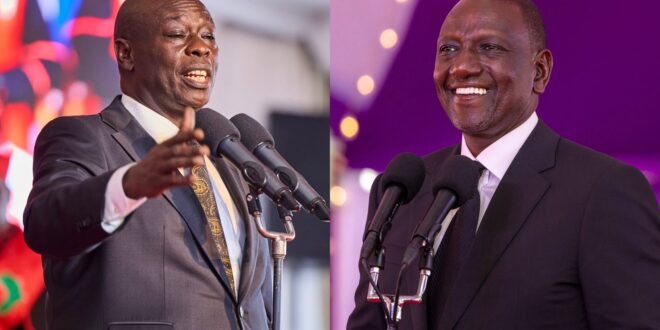
What may appear to be a routine local contest is quickly turning into a high-stakes political battle, one that could reveal shifting loyalties and reshape power dynamics in the Mt Kenya region.
Political analysts say the outcome could influence regional leadership and impact the direction of national politics ahead of upcoming elections.
Click here to join our WhatsApp Channel
At the heart of the race is a clash between Gachagua’s grassroots networks and Ruto’s advantage as the sitting president, supported by state influence. The by-election is widely viewed as a key test of whether Gachagua still holds strong backing in a region that played a crucial role in Ruto’s rise.
Analyst Fred Sasia notes that for the President, the Ol Kalou contest is about more than just a parliamentary seat. He says Ruto has been working to strengthen his grip on the region through development promises and strategic alliances, positioning himself as its main political anchor.
On the other hand, Gachagua has framed the race as a moment of resistance, urging voters to push back against what he describes as betrayal and the sidelining of Mt Kenya interests in government.
The rivalry between the two leaders has escalated in recent months following their political fallout, transforming their once-united front into competing centres of influence—now set to face off directly at the ballot.
Recent events in Mbeere North have further raised the stakes. There, Ruto and his deputy Kithure Kindiki secured a decisive win against candidates linked to Gachagua. The result was seen as proof of the Ruto-Kindiki team’s organisational strength and their ability to mobilise voters in Mt Kenya East, an area once considered favourable to Gachagua.
That victory boosted Kindiki’s standing as a regional mobiliser and hinted at a possible shift in power. It also energized Ruto’s allies, who now approach the Ol Kalou race with confidence and a growing narrative that Gachagua’s influence could be declining beyond certain strongholds.

Kindiki has already taken a combative stance ahead of the by-election, openly challenging Gachagua’s political weight and vowing another victory.
Gachagua, however, has dismissed claims that the Mbeere North outcome reflects his strength, noting that his party did not field a candidate in that race. He remains defiant, insisting his support in Mt Kenya remains firm—even stronger following his impeachment.
Speaking during the requiem service of the late Ol Kalou MP David Njuguna Kiaraho, Gachagua maintained that his bond with the region’s voters remains intact, drawing applause from sections of the crowd.
Ruto, in contrast, has adopted a more measured tone, focusing on development rather than direct confrontation. At the same event, he pledged to prioritise infrastructure and healthcare in the constituency, including completing stalled road projects and supporting the construction of a Level 4 hospital.
Despite this restrained approach, analysts argue the by-election is a defining moment for both leaders.
According to political analyst Samuel Owida, the race offers Gachagua a rare chance to directly challenge Ruto’s dominance in Mt Kenya and prove he can sway the region away from the President.
Gachagua’s recent strategy has involved selectively engaging in by-elections—backing allies in some areas while stepping aside in others. However, Ol Kalou is expected to be different, with observers predicting he will field a candidate directly aligned with his camp against Ruto’s UDA party.

Political commentator Joseph Mutua describes the contest as a “mini-referendum” on the country’s leadership. A win for Ruto’s side would affirm his continued popularity, especially in Mt Kenya, while a loss could signal weakening influence in a region central to his 2022 victory.
For Gachagua, the stakes are equally high. A strong performance would boost his political leverage and strengthen his position in any future coalition talks.
As campaigns gather momentum, the Ol Kalou by-election is increasingly seen as more than just a local race—it is a crucial test that could either reaffirm Ruto’s dominance or mark Gachagua’s emergence as a powerful political force in the region.