 The Lower Eastern Times Opening The Third Eye
Related Articles



By: Agnes Wanjira
When heavy rains fall over Nairobi, many residents welcome the relief from heat and the promise of greener surroundings.
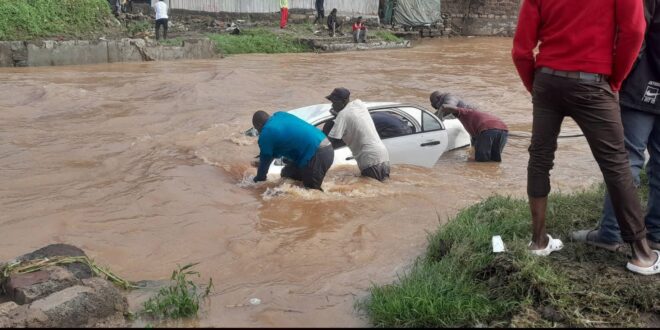
However, for thousands of people living in low-lying areas and informal settlements, the rains often bring anxiety instead of comfort. Floods have become a recurring reality, disrupting daily life, destroying property, and putting lives at risk.
Click here to join our WhatsApp Channel
During the rainy seasons, rivers such as the Nairobi River and the Ngong River frequently overflow after hours of intense rainfall. Water quickly fills streets, homes, and businesses, particularly in densely populated neighborhoods like Mathare, Kibera, and Mukuru kwa Njenga. Many houses in these areas are built close to riverbanks or in poorly drained zones, making them extremely vulnerable to flooding.
For residents, floods mean more than just water in the streets. Families are often forced to move their belongings to higher ground or temporarily leave their homes. Children miss school as roads become impassable, while traders struggle to protect their goods from water damage. In some cases, floods wash away small structures, leaving families without shelter.
Thirty-two-year-old mother of two, Mary Wanjiku, who lives near the Ngong River, describes the fear that comes with every heavy rainfall.
“When the rain starts at night, we don’t sleep. We keep checking the river level because the water can enter the house at any time,” she says.
Like many residents, she has learned to pack essential items in a small bag in case the family has to evacuate quickly.

Urban planners and environmental experts say that rapid urbanization is one of the key factors worsening flooding in Nairobi. Over the years, construction has taken place in natural drainage areas, reducing the land’s ability to absorb water. Blocked drainage systems, often clogged with garbage, further compound the problem by preventing rainwater from flowing freely.
Climate change has also played a role, with meteorologists noting that rainfall patterns are becoming more intense and unpredictable. Heavy downpours within short periods overwhelm drainage infrastructure that was not designed to handle such volumes of water.
