The Lower Eastern Times Opening The Third Eye

By: BBC
Two-time Olympic marathon champion Eliud Kipchoge says he feared for his family’s life during a campaign of online abuse against him that wrongly linked him to the death of fellow Kenyan marathon runner Kelvin Kiptum.
Kiptum, the world record holder who looked set to end Kipchoge’s victory over 26.2 miles, died in a road accident in February at the age of 24.
Some social media users began speculating that Kipchoge was part of a plot to kill Kiptum, who had lowered the world record to two hours, 35 seconds last October in Chicago.
“I was shocked that people [on] social media are saying ‘Eliud is involved in this young man’s death’,” the 39-year-old athlete told BBC Sports Africa.
“That was the worst news about me in my life.
“I was told many bad things; that they will burn that (training) camp, they will burn my property in the city, they will burn my house, they will burn my family.
“It didn’t happen but that’s the way the world is.”
Kipchoge’s initial reaction when he saw false rumors spreading online, the first thing he did was to check if his family was safe.
“I don’t have the ability to go to the police and tell them my life is in danger. So my concern was to tell my family to be more careful and careful,” he said.
“I started calling a lot of people.
“I was very afraid of my children going to school and coming back.
“Sometimes they ride bikes, but we had to stop them because you never know what will happen. We started dropping them off and picking them up in the evening.
“My daughter was at boarding school – that was a relief that she didn’t have access to social media, but it’s hard for my boys to hear ‘Your dad killed someone’.”
Losing friends and trust
Kipchoge was overcome with emotion during an interview at his home in Eldoret as he explained how cyberbullying affected his biological mother.
“My worst moment was (when) I tried to call my mom,” he said.
“He told me ‘Be careful’ and ‘A lot has been going on’.
“Our home is in the countryside. And at my mother’s age, I realized that social networks have reached everywhere.
“But he gave me courage. It was a very difficult month.”
However, Kipchoge, who became the third man to win consecutive Olympic races when he defended his title in Tokyo in 2021, decided not to take precautions about his safety.
“I didn’t see the need to change places to practice because my life is open,” he explained.
“Our sport is not training in the gym, it’s going outside to run. I walk the streets freely.”
Kipchoge claims he “lost about 90%” of his friends amid the false link between Kiptum’s accident and cyberbullying.
“It was very painful for me to learn even from my people, those we train together, those with whom I have contact, and bad words come from them,” he added.
“I was very sorry to see that.”
Impact on its performance
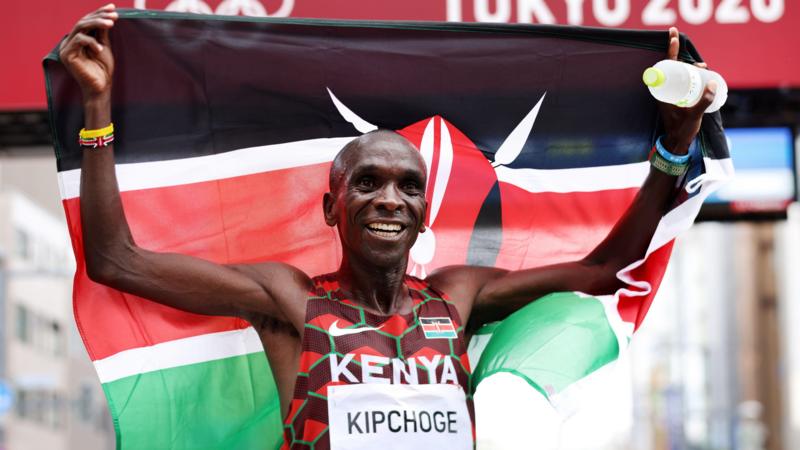
Kipchoge’s team decided to disconnect him from social media following the abuse, but he said he never considered deleting his accounts.
“If I delete my accounts, it shows that I am hiding something,” he said.
“I’ll keep my accounts. I didn’t do anything.”
However, he believes the misuse of social media affected his performance in competitions.
Kipchoge finished 10th in the Tokyo Marathon on 3 March, his lowest result since he started running in 2013, crossing the line two and a half minutes behind winner Benson Kipruto.
“When I was in Tokyo I didn’t sleep for three days,” he revealed.
“It was my worst result ever.”
Despite that defeat, he was named in Kenya’s marathon team for the Paris 2024 Olympics last week, and is now focusing on making more history at the Games as he aims to win a third consecutive gold medal.
“It means getting used to getting up and going straight again, to your goal,” added Kipchoge, who in 2019 was the first person to run a marathon under two hours, albeit in controlled conditions in Vienna.
“I want to go down in the history books, to be the first human to win back-to-back titles.”
Tackling violence in Paris 2024
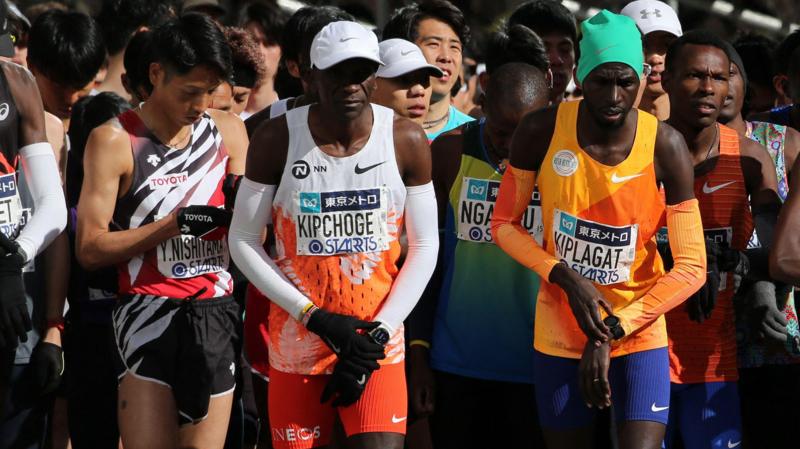
After facing threats and harassment online, Kipchoge believes that social media companies “have not taken steps” to prevent harassment on their platforms.
“These faceless people are publishing bad things and they are very dangerous,” he said.
“If you report some accounts, it takes time to close those accounts.
“They should act quickly, find the truth, delete the account. People [should] know that if you say something that is not good then your account will be closed.”
However, Kipchoge has welcomed the announcement from the International Olympic Committee (IOC), that it plans to “take proactive measures” to protect athletes from cyberbullying during Paris 2024.
The IOC intends to use artificial intelligence to help identify abusive posts and report them to social media companies.
“I think it’s the right direction,” he said.
“Now they are stamping their authority and their work as an organization dealing with athletes to protect them from abuse.”
But, for Kipchoge, it is already too late to avoid the emotional wounds he has suffered.
“I learned that friendships don’t last forever,” he said.
“I think it’s unfortunate that it happened when I’m celebrating more than 20 years in athletics.
“What happened has made me not trust anyone. Not even my own shadow, I won’t trust it.”