 The Lower Eastern Times Opening The Third Eye

Related Articles
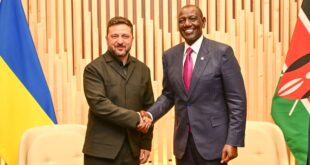

During a two-day official state visit to Japan, President William Ruto has successfully secured investments totaling Ksh.45 billion.
Government Spokesperson Isaac Mwaura made the announcement at the Kenyatta International Conference Centre (KICC) on Thursday, revealing that a substantial portion of the investment, Ksh.15 billion, will be directed towards the construction of a wind farm project in Meru.
“The Ksh.15 billion Meru Wind Farm Energy project is a significant step towards both environmental sustainability and economic efficiency. It holds the promise of generating numerous job opportunities and aims to reduce electricity costs, benefiting millions of Kenyans and fostering further investments,” Mwaura stated.
An additional Ksh.8 billion will be allocated for the development of a solar energy project in Isiolo County, with the aim of bolstering power supply into the national grid. Moreover, Ksh.800 million has been earmarked for the local manufacturing of Toyota vehicles.
“By initiating local vehicle manufacturing, Toyota will contribute to reducing the importation of over 120,000 vehicles from Japan, thereby creating more job opportunities in the vehicle manufacturing value chain across Africa,” Mwaura added, noting that Ksh.19 billion will be dedicated to the construction of the Menengai Geothermal Plant.
Mwaura further disclosed that Ksh.3 billion will be allocated to the Kenya Medical Research Institute (KEMRI) to enhance research efforts in developing tropical medicine to combat diseases like cancer and HIV/AIDS. Funding for this initiative will predominantly come from public-private partnerships and grants.
During the Kenya-Japan Business Forum in Tokyo, President Ruto urged Japanese businesses to explore investment opportunities in Kenya’s manufacturing, agriculture, and technology sectors. He emphasized that the government’s Bottom-Up Economic Transformation Agenda (BETA) has created numerous opportunities within these value chains.
President Ruto highlighted the mutually beneficial nature of the partnership, with Japanese companies gaining access to Kenya’s skilled workforce, while Kenya benefits from Japanese investment. He encouraged Japanese investors to take advantage of Kenya’s arable land, which has the potential to significantly contribute to global food security. Additionally, he emphasized the opportunities presented by Kenya’s membership in the East African Community and the African Continental Free Trade Area (AfCFTA) agreement, providing access to a market of 1.4 billion people.
