The Lower Eastern Times Opening The Third Eye
KCB Group has reported a sharp rise in its green lending, disbursing Sh48.8 billion in 2025 to finance environmentally friendly projects across East Africa, surpassing its sustainability targets.
The financing supported a wide range of climate-focused initiatives, including renewable energy, sustainable agriculture, green buildings, clean transport systems, water conservation and other eco-friendly developments, according to the bank’s 2025 Sustainability Report.
Click here to join our WhatsApp Channel
Out of the total amount, Sh9.9 billion was independently verified as climate-eligible through the Climate Assessment for Financial Institutions (CAFI) tool, underscoring the credibility of the green financing portfolio.
During the same period, KCB screened transactions worth Sh587.9 billion under its Environmental and Social Due Diligence framework across Kenya, Uganda, Tanzania and Rwanda, as it tightened oversight on responsible lending.
As a result, the proportion of the bank’s loan book allocated to green projects increased to 25.84 percent in 2025, exceeding its internal target of 25 percent and rising from 21.6 percent in 2024.
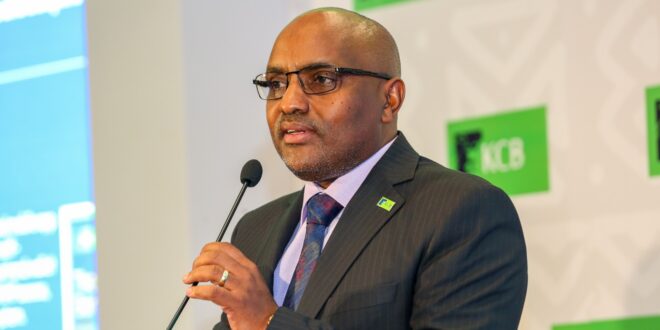
KCB Group Chief Executive Officer Paul Russo said the institution is increasingly embedding sustainability into its lending decisions to support climate resilience and long-term economic growth.
He noted that the bank aims to play a stronger role in building a sustainable financial ecosystem in East Africa by developing tailored green financing solutions for MSMEs, households and corporates, encouraging wider adoption of environmentally responsible practices.
Looking ahead, the lender plans to deepen partnerships with global climate finance institutions, expand its green lending products and mobilize additional funding to support the transition toward a low-carbon economy.
Beyond financing, KCB expanded its environmental initiatives significantly in 2025, planting more than 3.5 million trees—well above its target of 1.5 million—through over 200 planting activities conducted with 1,778 schools and other partners.
The bank also invested Sh782.5 million in cleaner cooking programmes, enabling 266 schools to adopt energy-efficient cooking technologies and reduce dependence on traditional biomass fuels.
In its renewable energy drive, KCB extended its solar power programme to 16 branches across the region, including locations such as Maasai Mara, Wajir, Mandera, Watamu, Lamu, Loitoktok, Kakuma and Namanga. Plans are underway to expand solar installations to 30 additional branches.
These sustainability efforts contributed to a 2 percent reduction in fuel and electricity use and a 13 percent drop in overall carbon emissions across the Group.
On the social front, KCB Foundation programmes supported more than 265,300 jobs, while 16,549 young people benefited from employability and skills development initiatives.
In addition, 38,635 youth-led enterprises were supported through the 2Jiajiri Young Africa Works programme, bringing the total number of enterprises backed by the Group to 67,090.
The bank also strengthened its commitment to women entrepreneurs, disbursing Sh149 billion to women-led businesses through its Female-Led and Made Enterprise initiative, part of a wider Sh250 billion financing target over five years.

KCB further expanded financial inclusion efforts among displaced populations, serving 20,299 refugees and disbursing Sh71.4 million in loans to refugee-owned businesses.
The Sustainability Report is the bank’s third to undergo independent assurance and has been prepared in line with IFRS S1 and S2 reporting standards ahead of their mandatory adoption in 2027.