The Lower Eastern Times Opening The Third Eye

By: Vincent Mumba
What you need to know;
- What does Raila Odinga truly stand for? The evidence suggests he stands for himself.
- His political journey has been one of shifting alliances, ideological inconsistencies, and strategic betrayals.
- His supporters are his greatest weapon, yet they are also his greatest victims.
Raila Odinga has spent decades branding himself as the face of Kenya’s struggle for democracy. His role in fighting for multi-partyism in the 1990s was pivotal, and his defiance against autocratic rule inspired a generation. But a closer look at his political career exposes a troubling pattern—one where every revolution he leads ends in a backroom handshake that benefits him far more than the people he rallies.
The Reformist Legacy
Odinga’s credentials as a reformist cannot be ignored. He was instrumental in the fight for multi-party democracy in the 1990s, challenging the authoritarian grip of KANU and President Daniel Arap Moi. He suffered for it—detained, harassed, and politically sidelined. His resistance to one-party rule helped open up Kenya’s democratic space, and for that, he earned his place in the country’s political history.
But reformists don’t just fight for change; they see it through. They build institutions, cultivate successors, and ensure that the struggles they championed do not become personal crusades. This is where Odinga’s legacy starts to unravel. Instead of strengthening democracy, he has built a political empire centered around himself. His party, ODM, is not a platform for ideological change but a vehicle for his ambitions. He is always at the center, never stepping aside for new leadership, never allowing a real movement beyond his name.
The Pattern of Electoral Defeats and Handshakes
If Raila Odinga were a true reformist, his persistence in presidential elections would be admirable. He has contested five times—1997, 2007, 2013, 2017, and 2022—each time claiming victory was stolen from him. His response? Protest, resistance, and mass action. Yet, what happens after every confrontation? A handshake. A truce. A deal that conveniently benefits him while his supporters, the ones who risk everything for him, are left stranded.
In 2007, after a disputed election that led to one of Kenya’s worst post-election crises, Odinga accepted a power-sharing deal, becoming Prime Minister in the Grand Coalition Government. While the deal ended the violence, it also marked the beginning of his handshake politics. The lesson was clear: if you make enough noise, you get a seat at the table.
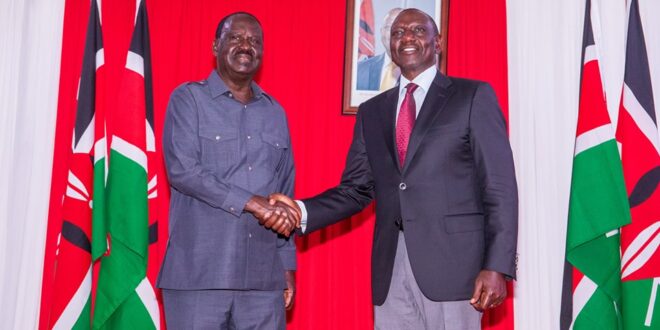
In 2017, history repeated itself. After leading protests against Uhuru Kenyatta’s government and boycotting the repeat election, Odinga pulled off yet another dramatic move—the infamous 2018 handshake with Kenyatta. Suddenly, the man who had been calling Kenyatta’s government illegitimate was now its closest ally. His supporters, who had braved bullets and police brutality in his name, were left bewildered. No electoral justice, no accountability, just a political arrangement that benefited two men at the expense of millions.
The Opportunist Unmasked
What does Raila Odinga truly stand for? The evidence suggests he stands for himself. His political journey has been one of shifting alliances, ideological inconsistencies, and strategic betrayals. He has partnered with almost every major political figure he once opposed—Moi, Kibaki, Uhuru, and even Ruto, whom he once branded as corrupt. Every alliance is built on convenience, not conviction.
His supporters are his greatest weapon, yet they are also his greatest victims. He mobilizes them, fuels their hopes, and directs their anger against the system, only to abandon them when it suits him. He speaks the language of struggle, but his actions betray a man more interested in personal political survival than in actual transformation.
A true reformist does not negotiate away the struggles of the people. A true reformist builds institutions, nurtures new leaders, and ensures that democracy is bigger than any one individual. Raila Odinga, however, has built a political legacy where he is the beginning and the end, where every struggle is a means to an end—his end.
The Fine Print of Betrayal: Raila Odinga’s Political Hustle
Raila Odinga is the grand architect of Kenyan political illusions. A man who storms into the battlefield waving the flag of reform but retreats into boardrooms when the smoke clears, leaving his foot soldiers stranded. His career is a masterclass in agitation without resolution, a carefully choreographed dance between defiance and compromise.
Look at his history. In the 1990s, he fought for multi-party democracy—a noble cause. But when the dust settled, he didn’t build a movement of principle; he built a machine of convenience. He has been in nearly every major political formation, shifting alliances like a gambler shuffling decks. From KANU to ODM, from opposition kingpin to government insider, Odinga’s ideology is not about democracy—it’s about staying relevant.
And then there’s his addiction to electoral chaos. He has lost elections, sure, but he has also mastered the art of losing profitably. Every time the presidency slips through his fingers, he turns the streets into battlegrounds, stirring the masses into action. Then, just when the pressure reaches its boiling point, he walks away with a handshake, a deal, a seat at the table. The people? Left with empty slogans and broken promises.
His 2018 handshake with Uhuru Kenyatta was the final nail in his credibility’s coffin. After years of calling Kenyatta’s government illegitimate, he suddenly became its biggest ally. What changed? Nothing, except the fact that Odinga got his cut of the power pie. The man who once spoke of electoral justice was now dining with the very system he claimed to fight
Kenya’s Greatest Sellout?
Raila Odinga’s greatest trick has been convincing Kenyans that he is the eternal opposition leader, the tireless reformist who never gives up. In reality, he is the ultimate political trader, a man who converts public discontent into private gain. His handshakes are not about peace or unity—they are about political convenience. His battles are not about democracy—they are about leverage.
Kenya does not need another season of Raila’s scripted resistance, another round of protests that end in a handshake. Kenya needs leaders who fight for reform and see it through. Raila Odinga has had his chance—many chances, in fact. And every time, he has chosen himself over the people.
He is not a reformist. He is not a revolutionary. He is the biggest sellout in Kenya’s political history.