The Lower Eastern Times Opening The Third Eye

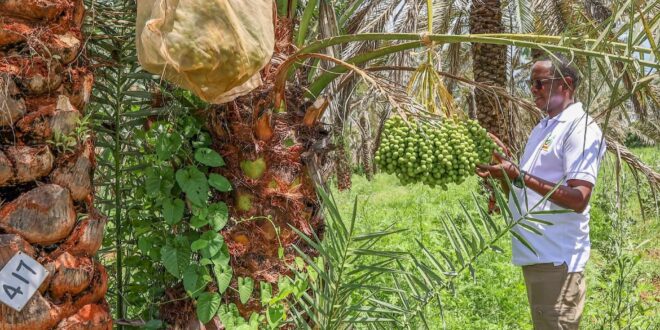
The Kenyan government is planning to establish a large-scale date palm industry in arid and semi-arid lands (ASALs) as part of efforts to cut import dependence and tap into a lucrative global market largely controlled by producers in the Middle East and North Africa.
The initiative was showcased during a visit by senior national and county officials to Kutch Farm in Kibwezi, Makueni County, where Indian and Israeli date palm varieties are being grown commercially, with some trees yielding up to 200 kilograms each.
Click here to join our WhatsApp Channel
The delegation included Agriculture and Food Authority (AFA) Director-General Bruno Linyiru, Council of Governors chair and Wajir Governor Ahmed Abdullahi, alongside technical experts from KEPHIS and KALRO. Officials observed the entire production process, from pollination and irrigation to harvesting and value addition.
Kenya’s local date production remains negligible, with about 1,100 kilograms recorded in 2023, yet the country spent over Sh359 million on date imports in 2024. This is despite Kenya having climatic conditions comparable to major producers such as Egypt, Saudi Arabia and the UAE.
Officials said the disparity highlights a major opportunity for ASAL counties, particularly as climate change continues to undermine conventional farming systems.
The team also evaluated intercropping models, where date palms are grown alongside mangoes, citrus fruits and vegetables—an approach seen as a way to maximise land use and diversify farmer incomes.
Experts noted that date palms are highly resilient, capable of withstanding extreme temperatures, saline soils and low rainfall, while remaining productive for several decades once established.
Counties earmarked for the programme include Wajir, Mandera, Marsabit, Turkana, Garissa, Kitui, Tana River and Makueni, where commercial date farming is expected to stabilise incomes and reduce vulnerability to drought.

Linyiru said expanding date palm production has become a national priority as Kenya looks to promote climate-smart, high-value crops suited to dryland regions.
At current market rates, premium export varieties such as Medjool can sell for up to Sh1,200 per kilogram, with projections indicating that a fully mature hectare could earn farmers several million shillings annually.
To support the rollout, the government plans to invest in certified nurseries, irrigation expansion, farmer training, as well as processing and packaging facilities, with the aim of positioning Kenya as a competitive regional producer while creating new income opportunities for ASAL communities.