The Lower Eastern Times Opening The Third Eye
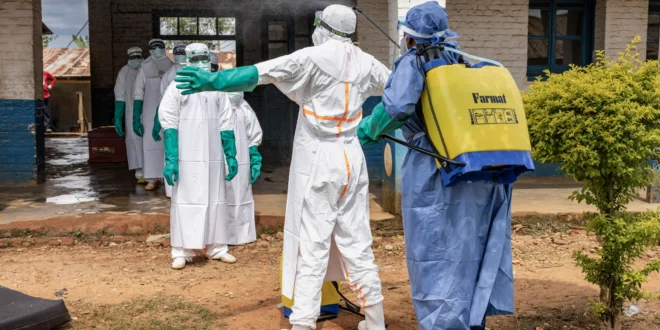
Kenya risks losing nearly 2,900 jobs and experiencing a slowdown in investment as the Ebola outbreak in the Democratic Republic of the Congo (DRC) continues to disrupt regional trade and business activity, a new United Nations Development Programme (UNDP) report has warned.
Although Kenya has not recorded any Ebola cases, the report says the country is already facing indirect economic effects through reduced cross-border trade, transport delays and declining investor confidence.
Click here to join our WhatsApp Channel
According to the Rapid Socioeconomic Assessment of Ebola Outbreak in the DRC, Kenya could lose around 2,900 jobs even if the virus remains largely contained within the DRC and Uganda. The report attributes the projected losses to stricter border controls, transport disruptions and weakening business confidence across the region.
By late June, the Ebola outbreak had claimed 291 lives in the DRC and infected 1,118 people, while Uganda had confirmed 62 cases and two deaths.
UN Assistant Secretary-General and UNDP Regional Director for Africa Ahunna Eziakonwa said Ebola extends beyond a health crisis, affecting livelihoods, education, food security, trade, public finances and public trust.
She warned that treating the outbreak solely as a medical emergency risks overlooking its wider socioeconomic consequences.
The report notes that Kenya’s greatest vulnerability lies in economic disruption rather than direct health impacts.
It explains that enhanced border screening, travel restrictions and quarantine measures have slowed the movement of people and goods, increasing transport costs and disrupting businesses that rely on regional supply chains and cross-border trade.
Across Africa, the study estimates the outbreak could reduce economic output by about US$2.37 billion and eliminate approximately 90,000 formal jobs, even if infections remain largely limited to the DRC and Uganda.
Angola is projected to record the highest job losses at around 16,600, followed by Kenya with nearly 2,900 and South Sudan with about 1,480.
UNDP said the economic consequences extend far beyond those infected, with vulnerable communities bearing the heaviest burden because they have limited financial resources to absorb the shocks.
The report further estimates that the DRC alone could lose more than US$1 billion in GDP and approximately 55,000 jobs under the baseline scenario.
It also cautions that the economic damage could worsen significantly if the Ebola outbreak coincides with other global challenges such as rising fuel prices or additional supply chain disruptions. Under such circumstances, Africa’s total economic losses could climb to US$3.6 billion, with as many as 328,000 jobs at risk.
Poor households are expected to suffer the greatest financial impact as disruptions to trade reduce incomes and weaken informal businesses.
Women are likely to be disproportionately affected because many depend on informal cross-border trade for income. They also make up a large share of frontline healthcare workers and family caregivers, increasing both their economic vulnerability and exposure to the virus.

UNDP warned that shifting excessive healthcare resources toward Ebola response could also lead to increased deaths from other illnesses by disrupting routine health services.
The assessment projects that interrupted healthcare in the DRC could result in up to 2,520 additional infant deaths from diseases unrelated to Ebola due to reduced access to essential medical services.
Kenya has stepped up preparedness efforts despite having no confirmed cases.
Health Cabinet Secretary Aden Duale recently announced that the government has allocated Sh1.7 billion toward Ebola preparedness, including surveillance, border screening, laboratory testing and emergency response measures.
The United States has also committed US$13.5 million to strengthen Kenya’s preparedness, including support for a quarantine facility at Laikipia Air Base, although construction of the facility has since been halted following a court order.
Speaking on June 25, Duale said Kenya had screened more than 140,000 travellers arriving from affected regions and investigated over 100 suspected cases, all of which tested negative for Ebola.
UNDP urged governments and development partners to view Ebola as both a health and development challenge, calling for greater investment in resilient healthcare systems, social protection programmes, livelihoods and stronger economic safeguards.
The report concludes that continued trade disruptions, border controls, transport delays and reduced consumer confidence could significantly slow economic growth across the continent, while the poorest households face declining incomes that threaten to reverse years of development gains.